Showing posts with label Global Issues. Show all posts

Wednesday, July 4, 2012

Problems of Working Women

It is an open truth that problems of working women are due to the male dominant society. Working women have to face problems just by virtue of their being women. Working women refers to those in paid employment. They work as lawyers, nurses, doctors, teachers and secretaries etc. Working women problems include mental harassment, physical abuse, sexual torture and time management. The main problem of working women is exploitation by other person of the society.

Working women face innumerable challenges and problems both at home and workplace. They are expected to do multi tasking. They have to take care of family and household and also work at offices. If problems of working women are not solved then they will not be able to work with full devotion. Men and women are pillars of society; without their equal participation society can never progress. There has been legislation that has afforded them protection but working women problems are not decreased yet.

Quotes on working women

- “Nature has given women too much power, the law gives them too little.”
- “The thing women have yet to learn is nobody gives you power. You just take it.” ~Roseanne Barr

Advantages of working women

The main advantage of working women is financial support for their families. They get ample amount to run a family. They are independent women who can take decisions of her life and a family on her own. They get exposure of society and community by working in workplace in different organizations.

Time management for working women

The major problem of working women is to manage time. They have to work a full time job, raise kids, and maintain home and health. Working women need to learn some basic time management skills that will help them to utilize maximum time. In order to balance work, home and family, it is very important to set priorities. They should organize work by making a list of things that have to be done within the day or week. This list should include both work and home related activities.

Working women magazine

In every year a lot magazines have been published for working women. They discuss the issues of problems of working women and suggested solutions. Health related tips, time management skills, cooking recipes and socio- economic role of working women are some topics discussed in these magazines.

Monday, June 20, 2011

Geographical perspective of human evolution

"History followed different courses for different peoples because of differences among peoples' environments, not because of biological differences among peoples themselves." Those who domesticated plants and animals early got a head start on developing writing, government, technology, weapons of war, and immunity to deadly germs.

Geography played an important role in human evolution. One of the biggest reasons of stratification in modern world is the difference among peoples' environments which divided them into "the haves and haves-nots.
Environmentalism, a basic concept of geography, played major role in current diversification in the world. 

Watch the first part of documentary based on Guns, Germs, and Steel: The Fates of Human Societies, in which author tries to explain why "people of Eurasian origin... dominate the world in wealth and power."

Guns, Germs, and Steel: The fates of Human Societies - Part 1

Diamond argues that Eurasian civilization is not so much a product of ingenuity, but of opportunity and necessity. That is, civilization is not created out of superior intelligence, but is the result of a chain of developments, each made possible by certain preconditions.


Guns, Germs, and Steel also offers a very brief explanation of why western European societies, rather than other powers such as China, have been the dominant colonizers.


Read More:
http://en.wikipedia.org/wiki/Guns,_Germs,_and_Steel#The_theory_outlined

Buy Book:
Guns, Germs, and Steel: The Fates of Human Societies


Friday, April 1, 2011

Some facts about Africa Migration


Following are some facts about Africa Migration which has been taken from  'Leveraging Migration for Africa: Remittances, Skills, and Investments'.
  • About 30 million Africans live outside their home countries, and migration is a vital lifeline for the continent.
  • These migrants sent home over $40 billion in remittances last year.
  • Their annual estimated saving, usually held in foreign countries, exceeds $50 billion.
  • Skilled migration poses special challenges of service delivery and loss of human capital, especially in poor countries with low education base, thus in part subtracting from the benefits of large remittances. 
  • Large investments in training people are going to be needed to bridge the gap between demand for and supply of skills in Africa. Restricting the emigration of high-skilled professionals in any form is a no-no.
  • Migration is mostly intra-regional, and informal. 
  • Migrants are mostly young and male. 
  • Sponsor's Ad:
  • The educated migrate to the North whereas the unskilled migrate within the region. 
  • The major reason for migration is to seek employment.
  • Land purchases, building a home, and starting a business were the highest uses of remittances sent home by African diaspora. As a share of total investment, these represented 36 percent in Burkina Faso, 55 percent in Kenya, 57 percent in Nigeria, 15 percent in Senegal, and 20 percent in Uganda. 
  • Education was the second-highest use of remittances from outside Africa into Nigeria and Uganda, the third highest into Burkina Faso, and the fourth highest into Kenya.
The report also outlines innovative financing mechanisms such as issuance of diaspora bonds and securitization of future remittance flows that can help finance big-ticket projects like railways, roads, power plants, and higher-education institutions that will, step by step, help to transform Africa.

The pdf version of this report, two companion volumes and 6 household survey data involving migration and remittances can be accessed at www.worldbank.org/migration. A report is completed. But a deeper engagement on leveraging migration for Africa’s development has begun.


Related Books:


Crackdown on Christians in Vietnam


The Vietnamese government has intensified repression of indigenous minority Christians from the country's Central Highland provinces who are pressing for religious freedom and land rights, Human Rights Watch said in a report released today.


The 46-page report, "Montagnard Christians in Vietnam: A Case Study in Religious Repression," details the latest government crackdowns on these indigenous peoples, known collectively as Montagnards. The report documents police sweeps to root out Montagnards in hiding. It details how the authorities have dissolved house church gatherings, orchestrated coerced renunciations of faith, and sealed off the border to prevent asylum seekers from fleeing to Cambodia.

Sunday, March 20, 2011

US launches missile attack on Libya


March 20 - 19:55GMT:  US reportedly launches missile attack on Libya, France says US would enhance assault on Gaddafi forces.


Political map of Libya

Political map of Africa


Political map of Africa

Sponsor's Ad:

U.S., France and England Geared for Libya War


The French government is opposing any aggression by Libyan leader Moammar Gadhafi against the population of Benghazi. According to CNN, French fighter jets patrolled over Libya today.

March 20 - 19:55GMT:  US reportedly launches middle attack on Libya, France says US would enhance assault on Gaddafi forces.

Political map of Libya with respect to France:

Political map of Libya - France

Related Books:
            

Wednesday, February 23, 2011

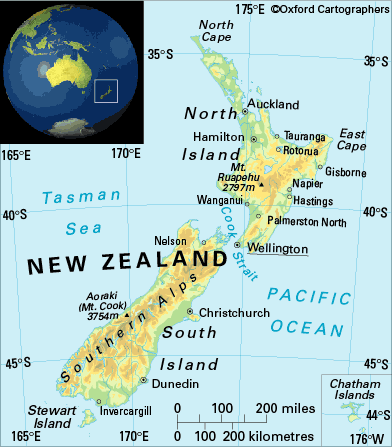
New Zealand Earthquake Map


Dozens trapped by New Zealand quake that killed 65. It was a 6.3-magnitude quake. 

Some Important facts about New Zealand Earthquake:

  • The February 21, 2011 South Island, New Zealand earthquake occurred as part of the aftershock sequence of the M 7.0 September 3, 2010 Darfield, NZ earthquake.
  • The February 21st earthquake involved oblique-thrust faulting at the easternmost limit of previous aftershocks, and like the mainshock itself is broadly associated with regional plate boundary deformation as the Pacific and Australia plates interact in the central South Island, New Zealand.
  • This latest shock is significantly closer to the main population center of Christchurch, NZ.
  • Sponsor's Ad:
  •  Since the September 3, 2010 mainshock, there have been approximately 6 M>=5.0 aftershocks in the Christchurch region.


Following image shows the Instrumental Intensity of New Zealand quake:


Below is the map of New Zealand:


Map of New Zealand

Tuesday, February 22, 2011

What is happening in Bahrain


King Hamad bin Isa al-Khalifa of Bahrain is the latest autocrat to choose brutality, rather than reform, to try to silence his people's demands for a more just government. His actions are unconscionable and miss the lessons of Egypt and Tunisia where violence only fed popular anger. Hosni Mubarak and Zine el-Abidine Ben Ali are now gone.

Protests in Bahrain were peaceful and festive on Wednesday when thousands of pro-democracy demonstrators - including children - bedded down in Pearl Square for the night. Hours later, hundreds of riot police stormed the area without warning, firing tear gas, concussion grenades, rubber bullets and shotguns.


Nicholas D. Kristof of The Times interviewed paramedics who said they were beaten for treating the injured. At least five people were killed. Two other protesters were killed earlier in the week.

Bahrain's pro-democracy movement was inspired by Egypt and Tunisia, but the grievances of its Shiite majority are longstanding. They compose 70 percent of the citizenry but hold only four of 23 cabinet slots. They are excluded from serving in the police and army. In last October's election, the Shiites won less than half of the seats in the National Assembly, raising charges of vote-rigging.

Sponsor's Ad:


King Hamad has repeatedly vowed both political and economic reforms but has never really delivered. Now the government is looking for a scapegoat - blaming Iran for the unrest. Tehran certainly never misses a chance to foment trouble. But the Shiites' demands are legitimate, and the appeal of Iran and other extremists will only grow if the government continues on this path.

For too long, the United States has muted its criticism of what goes in Bahrain, to ensure the kingdom's cooperation on security issues. Bahrain is home to the United States Navy's Fifth Fleet and an ally in efforts to counter Iran, terrorism and piracy.

After all of its backing and forthing on Egypt, we hoped the White House would have figured this one out. On Wednesday, President Obama criticized Iran's crackdown on pro-democracy demonstrators, and pointedly did not mention Bahrain. On Thursday, Secretary of State Hillary Rodham Clinton did better, expressing strong opposition to the violence and support for reform.

Bahrain's brutality is not only at odds with American values, it is a threat to the country's long-term stability. Washington will need to push harder.

Source: The New York Times

Sunday, February 20, 2011

Bahrain


Geography of Bahrain:
  • Bahrain comprises of thirty-three islands in the Persian Gulf, situated close to the shore of Arabian Peninsula.
  • The islands are about twenty-four kilometers from the east cost of Saudi Arabia and twenty-eight kilometers from Qatar.
  • The total area of the Bahrain is about 691 square kilometers. 
  • Sponsor's Ad:
  • The largest island, accounting for 83% of the area, is Bahrain island, which has an extent of 572 square kilometers. 
  • From north to south, Bahrain is forty-eight kilometers long; at its widest point in the north, it is sixteen kilometers from east to west.


Sunday, February 13, 2011

Egypt Erupts in Jubilation as Mubarak Steps Down

An 18-day-old revolt led by the young people of Egypt ousted President Hosni Mubarak on Friday, shattering three decades of political stasis here and overturning the established order of the Arab world. Shouts of “God is great” erupted from Tahrir Square at twilight as Mr. Mubarak’s vice president and longtime intelligence chief, Omar Suleiman, announced that Mr. Mubarak had passed all authority to a council of military leaders. 

Tens of thousands who had bowed down for evening prayers leapt to their feet, bouncing and dancing in joy. “Lift your head high, you’re an Egyptian,” they cried. Revising the tense of the revolution’s rallying cry, they chanted, “The people, at last, have brought down the regime.” 

“We can breathe fresh air, we can feel our freedom,” said Gamal Heshamt, a former independent member of Parliament. “After 30 years of absence from the world, Egypt is back.” 

Mr. Mubarak, an 82-year-old former air force commander, left without comment for his home by the Red Sea in Sharm el Sheik. His departure overturns, after six decades, the Arab world’s original secular dictatorship. He was toppled by a radically new force in regional politics — a largely secular, nonviolent, youth-led democracy movement that brought Egypt’s liberal and Islamist opposition groups together for the first time under its banner. 

One by one the protesters withstood each weapon in the arsenal of the Egyptian autocracy — first the heavily armed riot police, then a ruling party militia and finally the state’s powerful propaganda machine. 

Mr. Mubarak’s fall removed a bulwark of American foreign policy in the region. The United States, its Arab allies and Israel are now pondering whether the Egyptian military, which has vowed to hold free elections, will give way to a new era of democratic dynamism or to a perilous lurch into instability or Islamist rule. 

The upheaval comes less than a month after a sudden youth revolt in nearby Tunisia toppled another enduring Arab strongman, President Zine el-Abidine Ben Ali. And on Friday night some of the revelers celebrating in the streets of Cairo marched under a Tunisian flag and pointed to the surviving autocracies in Syria, Saudi Arabia, Jordan and Yemen. “We are setting a role model for the dictatorships around us,” said Khalid Shaheen, 39. “Democracy is coming.” 

President Obama, in a televised address, praised the Egyptian revolution. “Egyptians have made it clear that nothing less than genuine democracy will carry the day,” he said. “It was the moral force of nonviolence — not terrorism and mindless killing — that bent the arc of history toward justice once more.” 

The Muslim Brotherhood, the outlawed Islamist movement that until 18 days ago was considered Egypt’s only viable opposition, said it was merely a supporting player in the revolt. 

“We participated with everyone else and did not lead this or raise Islamic slogans so that it can be the revolution of everyone,” said Mohamed Saad el-Katatni, a spokesman for the Brotherhood. “This is a revolution for all Egyptians; there is no room for a single group’s slogans, not the Brotherhood’s or anybody else.” 

The Brotherhood, which was slow to follow the lead of its own youth wing into the streets, has said it will not field a candidate for president or seek a parliamentary majority in the expected elections. 

The Mubarak era ended without any of the stability and predictability that were the hallmarks of his tenure. Western and Egyptian officials had expected Mr. Mubarak to leave office on Thursday and irrevocably delegate his authority to Vice President Suleiman, finishing the last six months of his term with at least his presidential title intact. 

But whether because of pride or stubbornness, Mr. Mubarak instead spoke once again as the unbowed father of the nation, barely alluding to a vague “delegation” of authority. 

The resulting disappointment enraged the Egyptian public, sent a million people into the streets of Cairo on Friday morning and put in motion an unceremonious retreat at the behest of the military he had commanded for so long. 

“Taking into consideration the difficult circumstances the country is going through, President Mohammed Hosni Mubarak has decided to leave the post of president of the republic and has tasked the Supreme Council of the Armed Forces to manage the state’s affairs,” Mr. Suleiman, grave and ashen, said in a brief televised statement. 

Courtesy: NY Times

Wednesday, February 2, 2011

2010 ‘one of worst’ years for disasters: UN


GENEVA: 2010 was one of the worst years on record for natural disasters over the past two decades, leaving nearly 297,000 people dead, research for the United Nations showed on Monday.
The devastating earthquake in Haiti a year ago accounted for about two thirds of the toll, killing more than 222,500 people, according to the Belgium-based Centre for Research on the Epidemiology of Disasters (CRED).
The CRED found that the summer heatwave in Russia was the second deadliest disaster of the year, leaving 55,736 people dead according to figures it compiled from insurers and media reports of official sources.
The year was “one of the worst in decades in terms of the number of people killed and in terms of economic losses,” Margareta Wahlstroem, UN special representative for disaster risk reduction, told journalists.
“These figures are bad, but could be seen as benign in years to come,” she said, pointing to the impact of unplanned growth of urban areas, environmental degradation and climate change.
The economic cost of the 373 major disasters recorded in 2010 reached 109 billion dollars, headed by an estimated 30 billion dollars in damage caused by the powerful earthquake that struck Chile in February.
The earthquake unleashed a tsunami that swept away villages and claimed most of the 521 dead.
Summer floods and landslides in China caused an estimated 18 billion dollars in damage, while floods in Pakistan cost 9.5 billion dollars, according to the CRED’s annual study.
Although impoverished Haiti is still struggling to recover from the quake that devastated much of the capital, Port-au-Prince, it ranked lower down the global economic scale with an estimated eight billion dollars in losses.
Asians accounted for 89 percent of the 207 million people affected by disasters worldwide last year, the CRED said. – AFP
Source: Daily Dawn

Bookmark and Share

Sunday, January 23, 2011

Pakistan Floods 2010

  • Dated: July-August 201
  • Reason: Heavy monsoon rains in Khyber Pakhtunkhwa, Sindh, Punjab, Giligit-Baltistan and Balochistan regions of Pakistan.
  • Land underwater: One-fifth of Pakistan’s total land (maximum)
  • People affected: 20 million
  • Casualties: close to 2,000
  • Ban Ki-moon stated that the flood was the worst disaster he had ever seen. 
  • Structural damages: $4 billion +
  • Total economic impact: $43 billion
  • Since its inception the Federal Flood Commission (FFC) has received Rs 87.8 billion (about 900 million USD). But it proved unproductive during recent floods.
  • Homes destroyed: 1.89 million
  • People displaced: 6 million
  • Loss to power infrastructure: 10,000 transmission lines and transformers, feeders and power houses were damaged.
  • Loss to Infrastructure: 2,433 miles of highway, 3,508 miles of railways, 5,000 schools
  • Length of Indus River: 3,180 km

Sponsor's Ad:

A guide to Haiti Earthquake


  • Dated: January 12, 2010
  • Magnitude: 7.0 Mw
  • Casualties:  92,000 – 316,000
Sponsor's Ad:

  • It is 3rd deadliest earthquake
  • Region: Caribbean
  • Magnitude: 7.0 Mw
  • Epicenter: 25km west of Port-au-Prince
  • Plate: Gonava Plate between the much larger North American to the north and the Caribbean to the south.
  • Homeless people: 1.5 million
  • UN special envoy to Haiti: Bill Clinton


WikiLeaks - A new way to Journalism

What is WikiLeaks?
WikiLeaks is an international non-profit organization that publishes submissions of private, secret and classified media from anonymous news sources and news leaks. It is a media organization dedicated to bringing important news and information to the public. It is created by Jullian Assange in 2006 and is owned by The Sunshine Press.

What is the purpose of WikiLeaks?
WikiLeaks states that its "primary interest is in exposing oppressive regimes in Asia, the former Soviet bloc, Sub-Saharan Africa and the Middle East, but we also expect to be of assistance to people of all regions who wish to reveal unethical behaviour in their governments and corporations."


What is the legal status of WikiLeaks?
The legal status of WikiLeaks is complex. Assange considers WikiLeaks a whistleblower protection intermediary. Rather than leaking directly to the press, and fearing exposure and retribution, whistleblowers can leak to WikiLeaks, which then leaks to the press for them.


WikiLeaks states "...We derive these principles from the Universal Declaration of Human Rights. Article 19 inspires the work of our journalists and other volunteers. It states that everyone has the right to freedom of opinion and expression; this right includes freedom to hold opinions without interference and to seek, receive and impart information and ideas through any media and regardless of frontiers." 


Important Leaks?
  1. Video: Collateral Murder
  2. War Diary: Afghanistan War Logs
  3. War Diary: Iraq War Logs
  4. Cablegate: 250,000 US Embassy Diplomatic cables
  5. Tax Evasion by the Rich and Famous (Coming Soon)
How it affected the world?
It has become a "new way to journalism". Jasmine Revolution has also some roots in Diplomatic cables leaked by WikiLeaks. WikiLeaks also tells us that Information Technology Revolution has changed the world and has potential to spread the information to each corner of the world.


Friday, January 21, 2011

Why Nations Go to War?


Aggression is a human nature while War is a learned behavior. As psychology is science of behavior, we can discuss this topic under the psychological perspective that why nations go to war. Some abstract forces like nationalism, militarism, alliance system and economic issues play their role in starting a war. However, with regard to the problem of the outbreak of war, major wars of twentieth century indicate the crucial importance of the personalities of leaders. Let take the outbreak of World War II; there is no doubt that the victor’s peace of Versailles and the galloping inflation of 1920s brought the rise of Nazi Germany. But it was the personality of Hitler that was decisive.

More Examples:
  •  Emotional instability of Kaiser Wilhelm’s of Germany
  •  General McArthur’s personality because of which Korean War Prolonged by two years.
  • Fragile egos of American Presidents during Vietnam war
  • Volatile personality of Gamal Abdel Nasser of Egypt.
  •  Yahya Khan’s ego of not to be cowed down by a woman during 1971 Indo-Pak war.
  • Saddam’s and Khomeini’s personalities during Iran-Iraq war.

Misperception also played a vital role to start a war. This was in four different ways:

Sponsor's Ad:


  1.  Leader’s image of himself
  2. Leader’s view of his adversary character
  3. Leader’s view of his adversary’s intentions about himself
  4. Leader’s view of his adversary’s capabilities and powers.

Example for 'leader’s image of himself':

  • WW1 – Kaiser Wilhelm’s famous words that our soldiers will come before the leaves had fallen from the trees shows how he was overestimating his power.
  • WW2 – Hitler’s confidence in early German victory.
  •  Korean War – General McArthur’s overestimation of his power that Chinese military will not go to war with American military power even if he cross the 38th parallel line.
  • Vietnam War – During Vietnam War, each American soldier was thinking that just a few more bombs and then will come victory. This proved wrong when this war became the longest war of American history.
  • Arab-Israel Wars – Arab countries overestimated their capabilities when armies of four Arab countries invaded Israel. As a result, they lost Gaza strip and West Bank to Israel.
  • Indo-Pak Wars – After success in a minor military conflict at Rann of Kutch, Pakistan overestimated her power and started mission Gibraltar.
Example for ‘Leader’s view of his adversary character’:

  • WW1 – Kaiser Wilhelm once said “he hated the Slavs, even though one should not hate anyone.” This reflects his hatred toward Slavic peoples.
  • Vietnam War – American President Johnson’s words “Americans, the child of light, had to defeat the child of darkness in twentieth century crusade” shows his view about Asian communism.

5.    Examples for ‘Leader’s view of his adversary’s intentions about himself’:

  • WW1 – When Russians started military mobilization on defense out of fear of possible Austrian attack, Wilhelm considered it as preparation for a possible attack on Germany.
  • WW2 – Similar in case of WW2, Hitler was of the fear that England and France are ready on borders so he invaded both on eastern and western countries simultaneously.
  • Arab-Israel War – Because of fear of Israeli operation on Golan Heights, Syria and Egypt invaded Israel.

Examples for ‘Leader’s view of his adversary’s capabilities and powers’:

  •  Korean War – General McArthur, during his advance through North Korea toward the Chinese border, stubbornly believed that the Chinese Communists did not have the capability to intervene. When the Chinese did cross the Yalu River into North Korea.
  • Arab-Israel Wars – After three successful was, Israel viewed Arab power only with contempt and its own as unassailable. That was wrong, as Israel had to learn in the Vitter war of October 1973.

In short, the beginning of each war is a misperception. The war itself then slowly, and in agony, teaches the lesson of reality.
Source: Why Nations Go to War by John G. Stoessigner

Buy this book by John G. Steossinger: 

Tuesday, January 18, 2011

Some facts about Sino-American relations


- America was having $58 billion direct investment in China in 2005.
- More than 100 multinational American companies are operating in China. Mainly in Hotel and petrochemical industry.
- According to some estimates, China will cross the economic power of America in 2025.
- US is a military power. Total defense budget of America is more than the combined defense budget of 100 big nations.
- Total trade between China and America was 33$ billion in 1992. In 2005, it rose to $284.5 billion.
- Total trade deficit of America with China was $200 billion in 2005.
- China is second largest importer of America.

Important Issues between China and America:
- Devaluation of Currency (Yuan) by China
- Republic of China (Taiwan)
- North Korea
- Human Right Violence in China

Sponsor's Ad:


Saturday, January 16, 2010

The burka debate


NOW a draft bill is under consideration in the French parlia ment to impose a fine of 700 euros on any woman wearing a burka covering her whole body in any public place, and her husband twice as much if he forces her to wear the burka.

This is for the first time that women would be penalised for wearing the burka. Earlier France banned Muslim girls from wearing the hijab in schools. It argued that these religious symbols interfered with the state’s commitment to secularism and the French culture. In fact nothing happens without political ideology behind it. This measure is being championed by rightwing politicians who are exploiting anti-Islam feelings in France among a section of the people under the cover of secularism.

However socialists are opposed to any ban on the burka though they are not in favour of women wearing the burka. They feel women should be discouraged rather than banning the burka (which includes covering the face). Socialist spokesman Benoit Hamon announced that wearing the burka was not desirable but he did not favour a ban which would amount to an inconsistent ad hoc measure. “We are totally opposed to the burka. The burka is a prison for women and has no place in the French Republic,” he said. “But an ad hoc law would not have the anticipated effect.” The stand taken by the socialists appears to be quite logical. One cannot stop women from wearing the burka through a ban. It is quite undemocratic to punish one for wearing a certain type of dress. It is anti-democratic and anti-secular for a multicultural society. Let it be very clear that to cover the entire body, including the face, is not necessarily an Islamic way.

The Al-Azhar in Cairo has banned such a cover under an Islamic edict.

The ulema hold different views on the subject. A majority of them hold that covering the face and hands is not prescribed by the Quran or Sunnah. Only very few theologians and jurists want women to be fully covered. To compel women to so cover their bodies and face is indeed against women’s rights and dignity.

And a woman should be a free agent to decide for herself what to wear within decent limits and the cultural ethos.

However, this freedom also includes the right of women to cover their face, if they so desire and if they think it is a requirement of their religion. When I was lecturing at Bukhara University in a class of women students all of whom were wearing skirts with their heads uncovered, two women came fully covered including their faces. All other women demanded that these two burka-clad women be thrown out.

I told them to imagine that the burka-clad women were in a majority and two women had come wearing skirts with their heads uncovered, and the majority of the burka-clad women had demanded that those two women be thrown out — how would they feel? I, therefore, argued against getting violent just because someone dresses unlike us. We should have a dialogue with them and persuade them, if we can.


There could be a number of reasons why one prefers to wear a certain kind of dress. Maybe there is coercion by parents or husband which is undesirable. Or maybe one thinks it is a religious requirement or one tries to assert one’s right. Or maybe one is trying to fight cultural alienation. Certain dresses also become identity markers. Many Muslims who migrate from Asia and Africa experience a cultural shock when they see French or other European women wearing scanty dresses like bikinis. Thus they feel all the more compelled to wear their traditional dress.

Also, in France and several other European countries migrants are marginalised and feel alienated which pushes them into practising their own cultural norms. And then it is also to be remembered that all Muslim women in France do not wear such dress covering themselves fully. In fact many Muslim women have integrated themselves in French society by taking to western dressing.

A ban will only build up resistance among traditional Muslim women and they would try to defy the law resulting in social tension. It would be far better to resort to persuasive ways to discourage the more traditional women from wearing the all-covering burka.

Persuasion alone will not work unless backed by other measures, economic as well as social, to fight the alienation of religious and cultural minorities.

Thus, one needs multi-pronged measures to contain this problem. The Muslim ulema and intellectuals living in France also have to adopt creative ways to interpret Islamic traditional sources to address emerging conditions. It is necessary to revisit traditional sources which were rooted in a medieval, tribal/feudal culture.

Source: DAWN

Bookmark and Share

Wednesday, December 16, 2009

Source of Terrorism

ALTHOUGH there are still a couple of weeks to go before the new year, 2009 will go down in Pakistan’s exceptionally turbulent history as the country’s bloodiest year — bloodier than the time of ‘Operation Cleanup’ in the early 1990s in Karachi.
The security forces then dealt with a situation that was confined to one city, albeit the largest in the country and that was the result of warring groups seeking to establish their political and economic writ. It was not aimed at destroying the Pakistani state or establishing a new political, economic and social order. It was about control of the city. This time the state is the target. Pakistan is dealing with an insurgency that poses an exis tential threat.
Complicating the situation is the fact that the germs of this insurgency were planted by operators both within and outside Pakistan. According to popular belief the main reason for the development of extremism in the country was the involvement of the US in Afghanistan in the 1980s and the decision by Washington to pull out of the area that, in policy terms, it now refers to as AfPak.
The US left once the Soviet Union withdrew its forces from Afghanistan. But that is only a quarter of the explanation. There were several others. Among these was the social and political engineering of Gen Ziaul Haq who decided on his own and without the aid of public support that Pakistan needed to adopt Islam as the basis of its economic, political and social systems.
Under him, the country went through a wrenching change which was aided and abetted by the several Arab states with which his government had become closely associated. Saudi Arabia was particularly important in pushing Pakistan in that direction. It had helped finance Mujahideen efforts in Afghanistan and also financed the founding and development of a number of madressahs in large cities.
These madressahs taught a version of Islam that was mostly foreign to Pakistan. This is how Wahabi Islam struck roots in Pakistani soil. It flourished in particular in those areas whose people had been exposed to it because of their sojourn in Saudi Arabia.
One relatively less understood reason for the rapid growth of this more orthodox interpretation of Islam is the channel it found through the temporary migration to the Gulf states from Pakistan’s northern areas. This lasted for a decade and a half, from the mid1970s to the early 1990s, and involved several million people from northern Punjab and the NWFP. These workers were hired on fixed contracts, stayed in camps near the construction sites, and spent a good deal of their spare time in the mosques. They thus came under the influence of the local imams steeped in the Wahabi tradition. They brought this interpretation with them when they returned to Pakistan.
Also contributing to the problem is the fact that Pakistan’s political development was arrested because of the repeated involvement of the military in politics. The state’s priorities kept on changing as the leadership provided by the military in politics changed. But there was one thing common in the way all four military dictators governed. They had little confidence in the political will of the people they governed; all knowing, they ruled the country according to their particular whims.
Ayub Khan believed in limited democracy. He called it basic democracy. Ziaul Haq believed in what he thought was the Islamic way — the people should be governed by a pious leader who should not be constrained by the expressed wishes of the people. His only obligation was to consult a group of wise people chosen by the pious leader and assembled in a forum he called the shura.
Pervez Musharraf went back to the Ayubian formula by limiting democracy to a system of local government and a king’s party controlling a largely inconsequential national legislature. Being military men, these leaders believed in strong command and control systems in politics and economics .Since they were distant from the people they could not build popular support for their policies.
By far the most important contributor to the rise of extremism was the way a series of administrations managed the Pakistani economy. For many decades Pakistan experienced one of the sharpest increases in the rate of population growth. The country’s population at the time of independence was only 32 million of which 10 per cent lived in urban areas. It has increased almost five and a half times to 170 million on the eve of 2010.
This implies an average rate of growth of over three per cent sustained over a period of 60 years. Although the country has not held a population census for many years, I believe that nearly a half of this large and growing population is now urban. The urban population has increased at the rate of 4.5 per cent a year, again one of the highest in the world.
Unfortunately these demographic developments were not factored into the making of economic policy. Islamabad should have focused not only in getting the economy to grow rapidly — which it did on occasions and during the periods when the military was in charge – but also on ensuring that the rewards of rapid growth were widely distributed. The result is that the country now has millions of alienated youth with little faith in their future. They have been successfully recruited to jihadist causes. The latest of these is the destruction of the Pakistani state.
In developing an approach towards growing extremism and terrorism it is breeding, policymakers as well as the citizenry must first understand its complex causes. By focusing on just one aspect — the American pressure to go after the perpetrators of terrorist activities — the country will not be able to evolve a cogent response.
by Shahid Javed Barki
Source: Dawn
Bookmark and Share

Related Posts

Related Posts Plugin for WordPress, Blogger...